
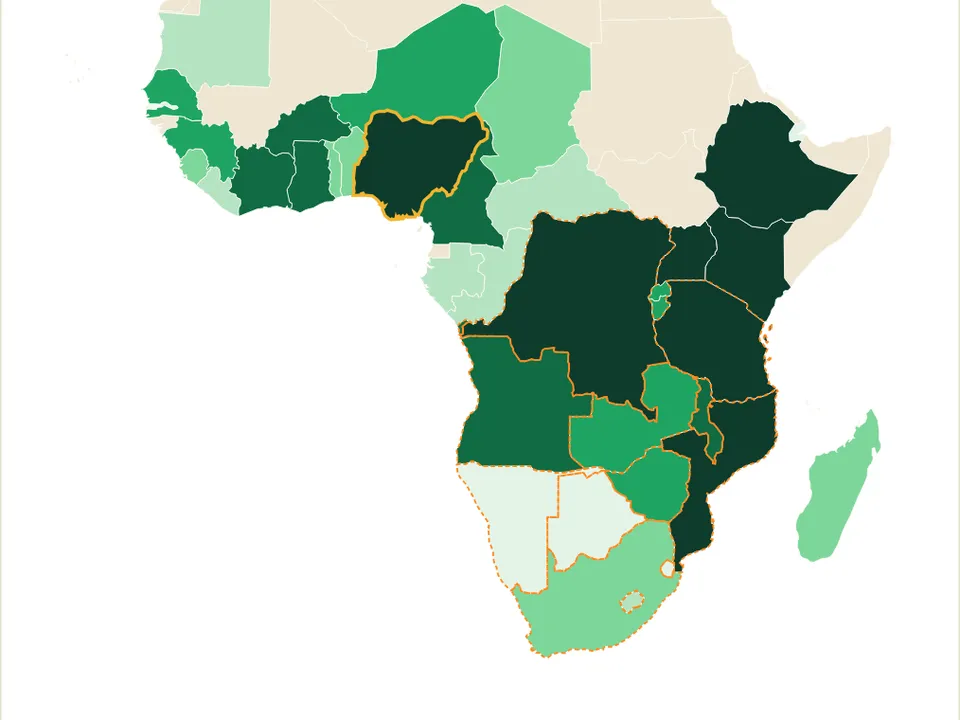
The compacts are long, written in different formats and counted in different units: people, households or connections. That makes them hard to compare. So we pulled the same eleven things out of each one, quoted each value with the page it comes from, and wrote down "not stated" wherever a compact is silent. Nothing is scored or ranked.
What they agree on
- Cost-reflective tariffs. 32 of 35 compacts commit to them; the other 3 mention them.
- A plan behind the targets. 29 say a least-cost or geospatial electrification plan already exists; 6 promise one.
- Productive use. 11 set a target or a funded program for farms, enterprises or irrigation, and 22 more mention it.
Where they differ
Grid, mini-grid or solar. 23 compacts split new access between the grid, mini-grids and standalone solar; 8 give only grid against off-grid, and 4 give no split. In the 19 that give both a split and a number of people, mini-grids carry about a quarter of the plan: roughly 62 million of 251 million people. The share runs from 56% in the DR Congo and 40% in Madagascar down to a few percent.
When the grid arrives. A mini-grid built today may meet the main grid in five years. 18 compacts set rules or commitments for that moment, such as interconnection or compensation; 15 mention mini-grid rules without it.
What happens to the hardware. Only 4 compacts make a specific commitment on e-waste, batteries or the end of life of solar products, and 2 more mention it. Yet the solar systems and mini-grid connections they plan would, by our estimate, retire somewhere between about 3,000 and 91,000 tonnes of batteries and panels every year once they are all in use. The spread is wide because battery choices matter so much.
Beside the map
For every country, the Compacts tab sets the compact's plan next to what our grid-edge atlas shows: how many people without night-time light live under 2 km, 2 to 15 km and over 15 km from a power line. In the same 19 countries, about 105 million people live 2 to 15 km from a line, close enough to plan for the grid's arrival and too far for a quick connection. That band is where grid-ready mini-grids make the most sense, and it is larger than the mini-grid share of most plans.
That comparison is a reading aid, not a verdict. Compacts were written for different purposes and count differently, and our map uses night lights as a proxy for access.
Kept up to date
The World Bank publishes progress reports for the compacts twice a year. 12 have one so far. We check for new compacts and reports every month and add them, with the source for each value.
Compare them yourself
Pick up to five countries in the atlas and their compacts line up side by side, with every quote and page. To read them as text, see all 35 compacts, country by country. Spot a value we got wrong? Email [email protected].
← All posts · More: Mission 300 energy compacts, side by side