Policy brief · November 2026 · 6 pages · version 1.1 adds a map
Wires are not the limit: why Africa's power pool interconnectors carry less than their rating
Every cross-border link in the Southern African Power Pool, with its rating and the limit SAPP applies, beside the main links of the Eastern Africa Power Pool and what they actually carry.
Key finding: SAPP's 25 cross-border links are rated at 11,400 MW but allowed about 7,760 MW (68%), and stability sets the limit on 24 of them. The Ethiopia-Kenya HVDC line, rated 2,000 MW, carried a 200 MW peak contract until late 2026.
Free under CC BY 4.0: share and reuse with credit. Cite as: Simons, B. (2026). Wires are not the limit: why Africa's power pool interconnectors carry less than their rating. Policy brief, version 1.1. Aloe Energy.
Position paper · November 2026 · 12 pages
Power first, grid next: why mini-grids need a rethink
Why mini-grids near the grid should be planned as future parts of it: an open screening of Zambia's 66, 33 and 11 kV networks, what solar and batteries at the end of weak lines do for losses and the evening peak, and what happened in eight countries when the grid reached their mini-grids.
Key finding: Solar with batteries on about 210 constrained Zambian feeders cut modeled losses by about 39% and the evening peak by about 300 MW; solar alone moved neither. Abroad, mini-grids survived the grid's arrival where rules were put in place and used, and were mostly abandoned where there were none.
Free under CC BY 4.0: share and reuse with credit. Cite as: Simons, B. (2026). Power first, grid next: why mini-grids need a rethink. Position paper, version 1.0. Aloe Energy.
Research paper · November 2026 · 8 pages
Can small hydro run a data center? Small hydropower and computing in Africa
Where small run-of-river hydro and computing could help each other in Africa: 381 small hydro sites mapped against eight factors, three real cases, nine candidate regions side by side and what a developer would need to check next.
Key finding: computing that can pause fits small hydro well; a data center that must always run cannot rely on the river alone. 72% of small plants run below 5% of capacity in the driest month of a dry year. The Albertine Rift lines up on the most factors at once.
Free under CC BY 4.0: share and reuse with credit. Cite as: Simons, B. (2026). Can small hydro run a data center? Small hydropower and computing in Africa. Aloe Energy. Version 1.4.
Research paper · November 2026 · 6 pages
When the river runs low: hydro dependence and drought exposure in the Southern and Eastern African power pools
How much of each of 17 grids between the Zambezi and the Nile is hydro, what a dry year takes away in megawatts under two modeled cases and as observed in 2024, and whether the interconnectors can carry the difference.
Key finding: Zambia lost 37% of its hydro output in 2024, about 730 MW on average, while the lines that bring power into the country had room for about 430 MW. The global datasets still show no drought at all.
Free under CC BY 4.0: share and reuse with credit. Cite as: Simons, B. (2026). When the river runs low: hydro dependence and drought exposure in the Southern and Eastern African power pools. Aloe Energy. Version 1.0.
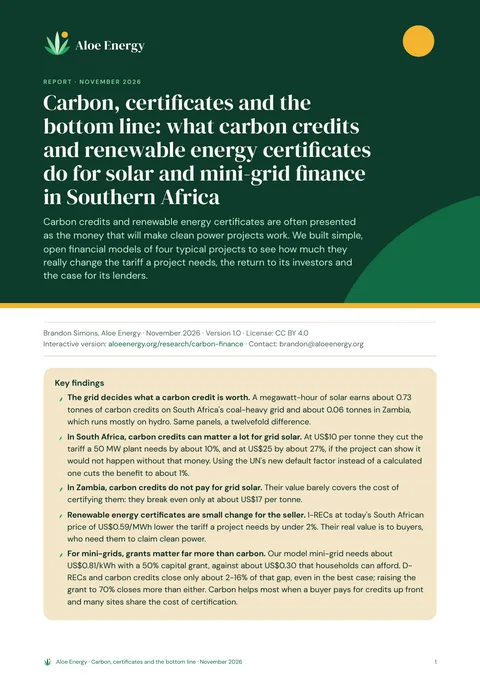
Research paper · November 2026 · 11 pages
Carbon, certificates and the bottom line: what carbon credits and renewable energy certificates do for solar and mini-grid finance in Southern Africa
Open financial models of grid solar in South Africa and Zambia, rooftop solar and a solar mini-grid, testing how much carbon credits, I-RECs and D-RECs change the tariff a project needs, its returns and the case for its lenders.
Key finding: Carbon credits at US$10 per tonne lower the tariff South African grid solar needs by about 10%, but barely cover their costs in hydro-powered Zambia. For mini-grids, grants matter far more than carbon or certificates.
Free under CC BY 4.0: share and reuse with credit. Cite as: Simons, B. (2026). Carbon, certificates and the bottom line: what carbon credits and renewable energy certificates do for solar and mini-grid finance in Southern Africa. Aloe Energy. Version 1.0.
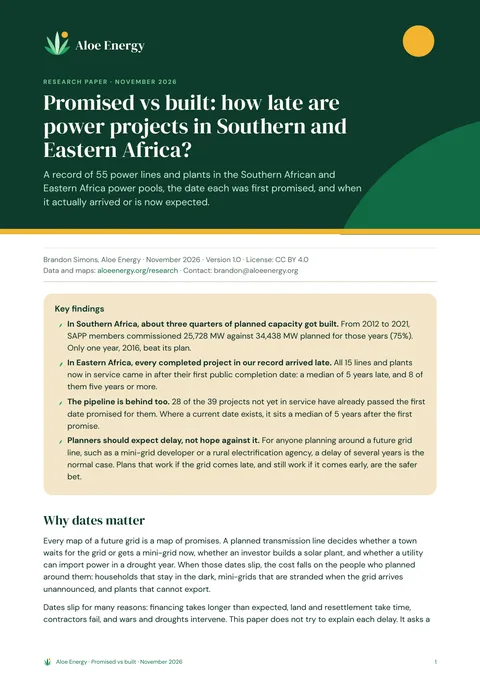
Research paper · November 2026 · 7 pages
Promised vs built: how late are power projects in Southern and Eastern Africa?
A record of 55 power lines and plants in the Southern African and Eastern Africa power pools: the date each was first promised, and when it actually arrived or is now expected.
Key finding: All 15 completed Eastern African projects in the record arrived late, a median of 5 years after their first promised date. SAPP members built 75% of the capacity they planned for 2012 to 2021.
Free under CC BY 4.0: share and reuse with credit. Cite as: Simons, B. (2026). Promised vs built: how late are power projects in Southern and Eastern Africa? Aloe Energy. Version 1.0. A DOI will be added soon.
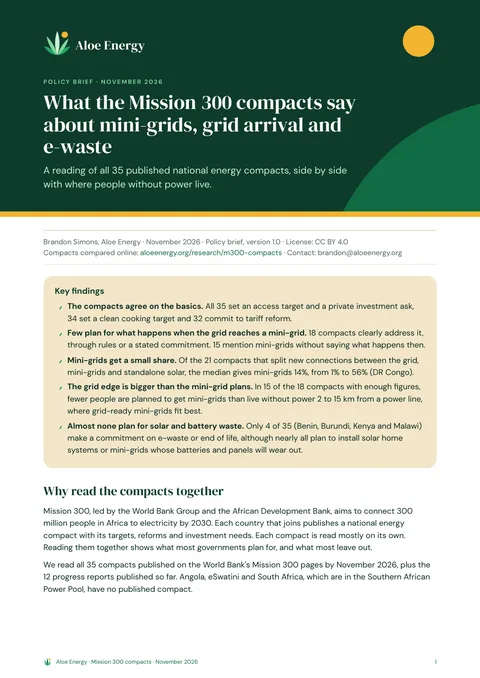
Policy brief · November 2026 · 5 pages
What the Mission 300 compacts say about mini-grids, grid arrival and e-waste
A reading of all 35 published Mission 300 national energy compacts, side by side with where people without power live.
Key finding: Only 18 of 35 compacts clearly address what happens when the grid reaches a mini-grid, and only 4 commit to anything on solar and battery waste.
Free under CC BY 4.0: share and reuse with credit. Cite as: Simons, B. (2026). What the Mission 300 compacts say about mini-grids, grid arrival and e-waste. Policy brief, version 1.0. Aloe Energy. A DOI will be added soon.
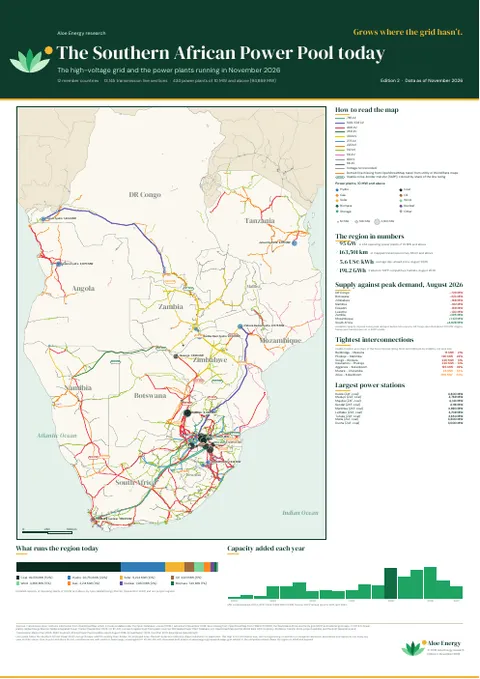
Poster · November 2026 · A0
The Southern African Power Pool today
The high-voltage grid and the 434 power plants running in the 12 SAPP countries, with supply against peak demand, the tightest interconnections and the largest power stations.
Free to print and share for non-commercial use with credit to Aloe Energy, unchanged (CC BY-NC-ND 4.0). A0 (841 x 1189 mm); prints well at A1 too.
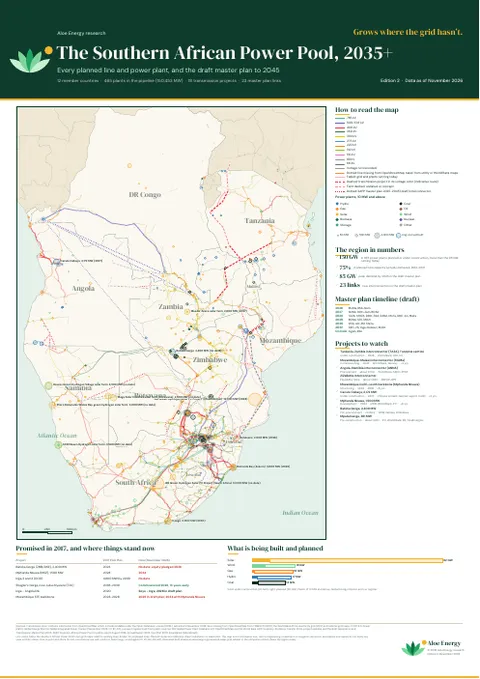
Poster · November 2026 · A0
The Southern African Power Pool, 2035 and beyond
Every planned transmission line and power plant, and SAPP's draft master plan to 2045, drawn over today's grid. With the master plan timeline and what the 2017 plan promised.
Free to print and share for non-commercial use with credit to Aloe Energy, unchanged (CC BY-NC-ND 4.0). A0 (841 x 1189 mm); prints well at A1 too.
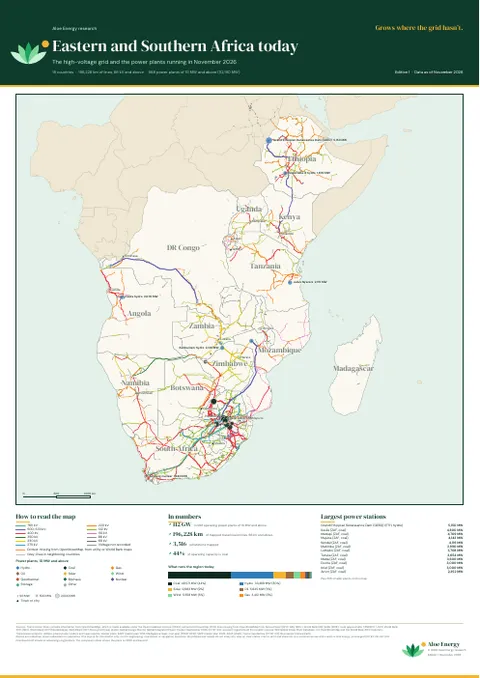
Posters · November 2026 · A0 and A2
Free grid posters for 18 countries and three regions
A poster pair for every country in our grid atlases, and for EAPP and the whole of Eastern and Southern Africa: the grid and power plants today, and everything planned to 2035 and beyond.
Free to print and share for non-commercial use with credit to Aloe Energy, unchanged (CC BY-NC-ND 4.0).