
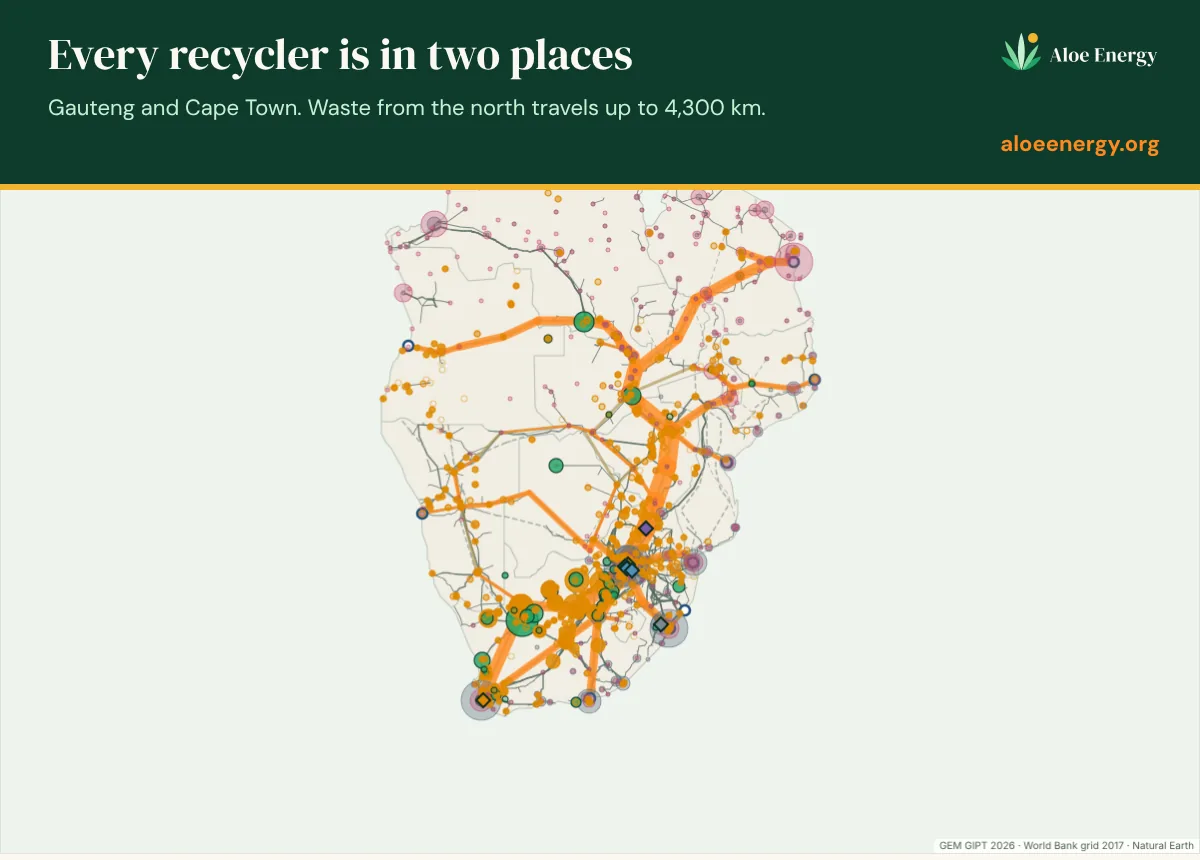
We built the second-life atlas to see that wave coming. It maps what will retire, when and where, across the 12 Southern African Power Pool countries, so that plans for reuse and recycling can start before the waste exists, not after.
The size of the wave
About 36 thousand tonnes of solar panels and batteries retire in 2035 alone across the region. By 2040 that rises to about 86 thousand tonnes a year.
Not all of it is waste. Between 2026 and 2040, about 10 GWh of retired batteries should still be good enough for second-life storage. That is worth roughly US$0.4-0.8 billion, and it is storage that rural homes, clinics, shops and mini-grids could use.
The small stuff comes first
It is easy to picture big solar farms being dismantled. But before 2035, most retiring equipment is small:
- early panel failures and repowering of older sites
- solar lanterns and solar home systems
- the home batteries South Africans bought during load-shedding
Large solar farms and grid batteries only retire in volume from the late 2030s.
Electric vehicles follow a similar pattern. Electric motorbike swap batteries are the near-term opportunity, a good fit as storage for solar home systems. Car and bus packs will not meet large storage needs before the mid-2040s.
That matters for planning. The first jobs in this sector are in collecting, testing and rebuilding small batteries and panels, not in large industrial plants.
The northern gap
Today, all of the region's battery and panel recyclers are in South Africa, around Gauteng and Cape Town.
Waste from Tanzania, the DR Congo, Angola or Zambia would travel 1,700 to 4,300 km and cross two to four borders to reach one. Each crossing needs a separate permit for hazardous waste. In practice, much of it will never make the trip. It will sit in storerooms, get burned, or end up in the ground.
That makes a strong case for a northern hub, for example around Lusaka or the Copperbelt, for testing, second-life rebuilds and collection. A hub like that keeps value and jobs close to where the equipment was used.
One more lesson from the numbers
Recovering materials from solar panels only pays when silver is recovered too. Any recycling plan for the region has to start from that.
How we made the estimates
Every solar and battery project in the regional pipeline is weighted by its chance of being built, then aged with standard retirement curves from IRENA and the IEA. Smaller streams, from home systems to electric vehicles, are added from national statistics and clearly labeled assumptions. Each load of waste is then routed along the main road and rail corridors to the nearest recycler.
These are estimates with stated assumptions, not forecasts. You can select any project on the map to see its sources. Main sources: Global Energy Monitor's Global Integrated Power Tracker, a battery storage register built from public announcements, the World Bank Africa electricity grid (2017), and IRENA and IEA PVPS end-of-life studies.
Why this matters to us
Aloe Energy started with a single question: what happens to batteries when they wear out? Our first research rebuilt used hybrid car batteries into solar storage. This atlas asks the same question at the scale of a whole region.
We update it every month as new solar and battery projects, recyclers and EV figures appear. The full report, "More than one life", is in preparation.
Explore and get involved
If you run a recycler, a battery business or a collection program in the region, or you want to review the report, email [email protected].