
Grows where the grid hasn’t.
Can small hydro run a data center?
Many small hydro plants in Africa have more power than the town around them can use, and computing needs cheap, clean power. We mapped 381 small hydro sites against fiber, cooling, the grid, dry seasons and the people nearby to see where the two could fit, and where they do not.
A customer for the spare power
- Small hydro needs a customer. Many plants were built for a town or mini-grid whose demand grew slower than planned. A computing load can buy the spare power and make the plant pay, while the community keeps first call on it.
- Computing can follow the river. Batch work, model training and bitcoin mining can run harder in the wet season and slow down in the dry season, which is how a run-of-river plant with no reservoir behaves.
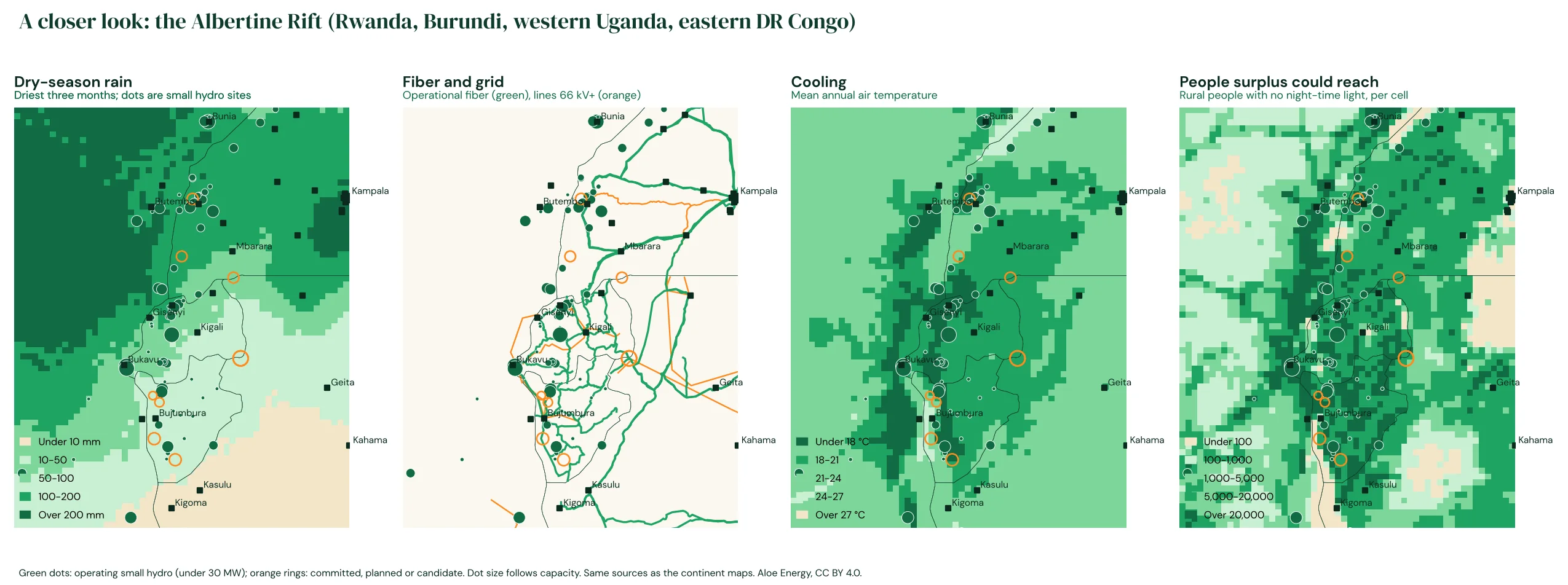
- Highland sites cool themselves. Many small hydro sites are in cool highlands, where outside air can do much of the cooling. In the Albertine Rift three in four sites have a mean annual temperature under 21 °C.
- It is an anchor load. A steady, paying customer is what makes a mini-grid worth building to grid standard, and the grid connection then becomes its backup.
Dry seasons, scale and fiber
- The river runs low. Run-of-river output depends largely on the rain. In a dry year most small plants produce close to nothing in their driest month. Our hydro and drought analysis shows the same risk for whole grids.
- Scale. The median small hydro site on our map is about 6 MW. Commercial data centers need tens to hundreds of megawatts and sit near the big cities and cable landings.
- Fiber and backup. Most workloads need fast links and a second route. Uptime-rated sites need a second power feed; even city sites keep large diesel reserves.
- Remote sites and volatile customers. Remote sites cost more to staff, secure and maintain. Bitcoin revenue swings with the price, and rules can turn quickly.
- Rules, water and who benefits. Licensing for self-supply, data location and water rights differ by country. A pairing only helps the community if the contract says so.
Three cases
We found no uptime-rated data center in Africa that runs mainly on small hydro. A planned project in Lesotho relies on 1,200 MW of large hydro plus solar and storage and is still at the memorandum stage. Sources: MIT Technology Review (2023), The Continent (2025), CNBC (2024), Ethiopian Business Review (Aug 2026), Capital Ethiopia (Sep 2026), africa.com (Jul 2026).
Eight factors, one map each
Each map shows one factor across Africa. We do not add them into a score: a site that is cool but dry, or wet but far from fiber, is a different proposition, and the reader is better placed to weigh that than a formula. Click a map to open it full size.
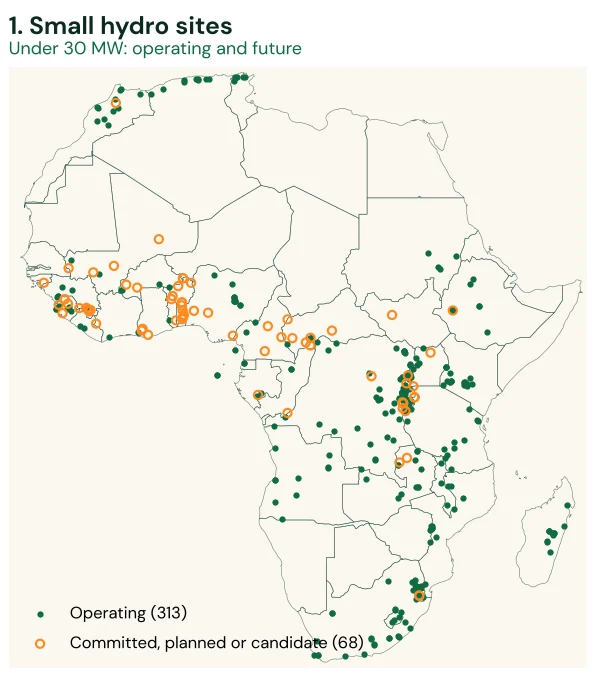
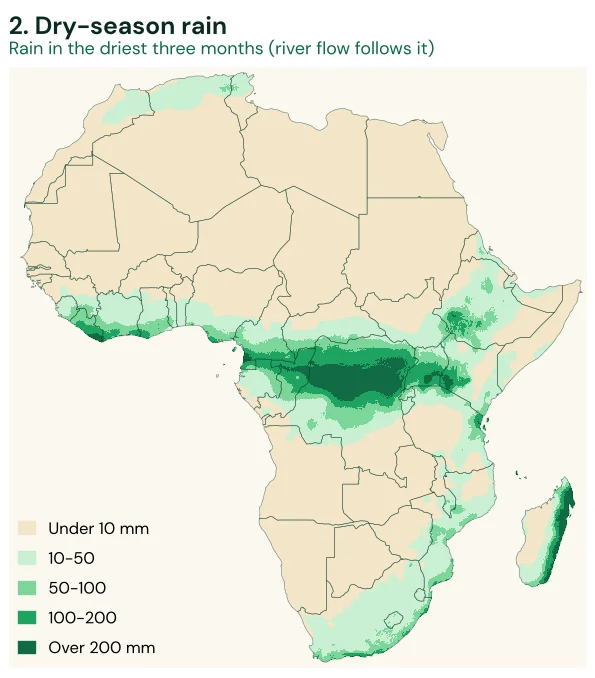
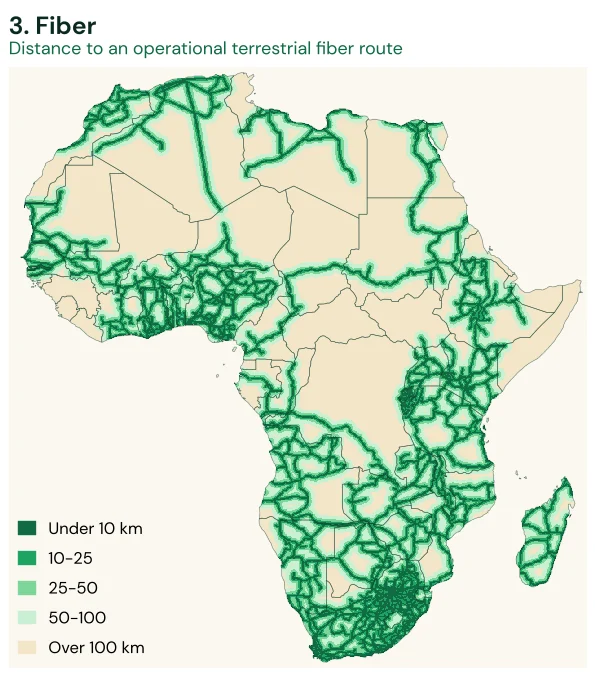
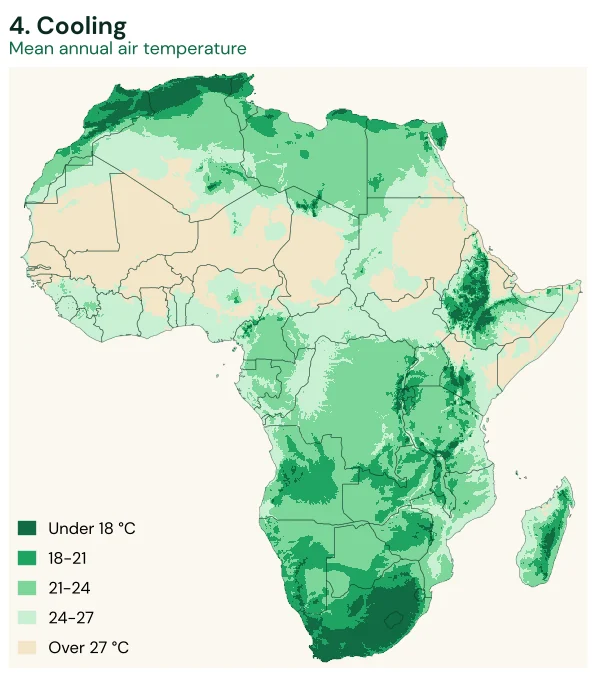
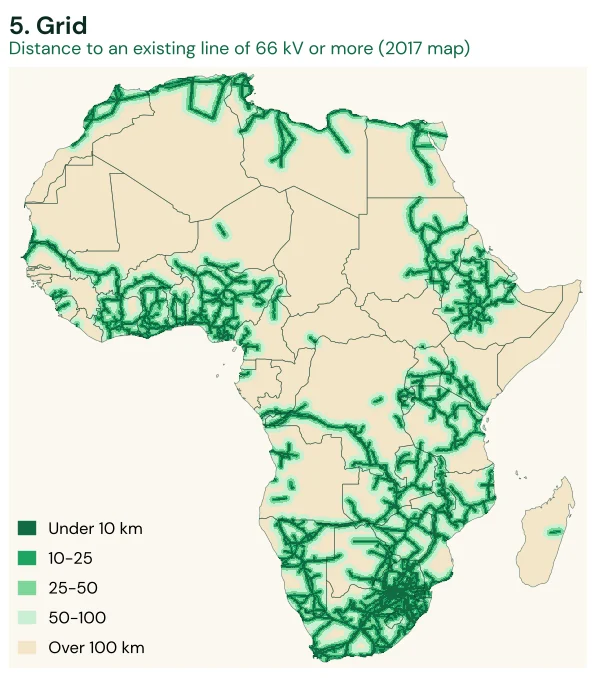
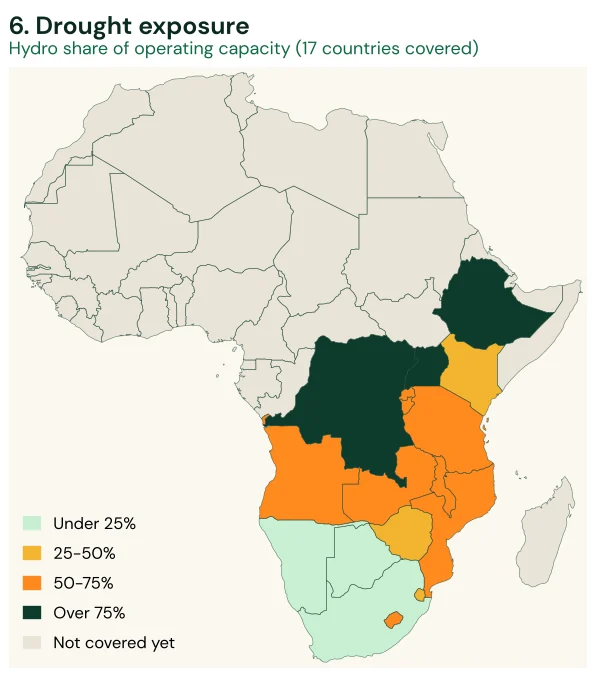
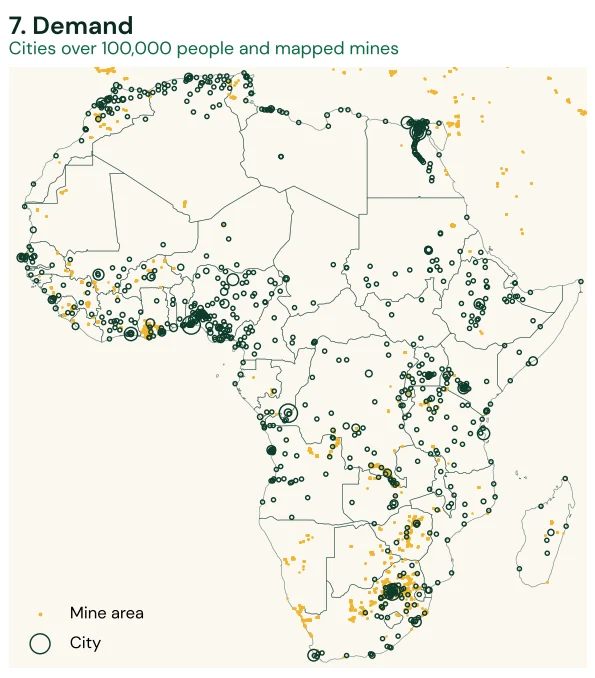
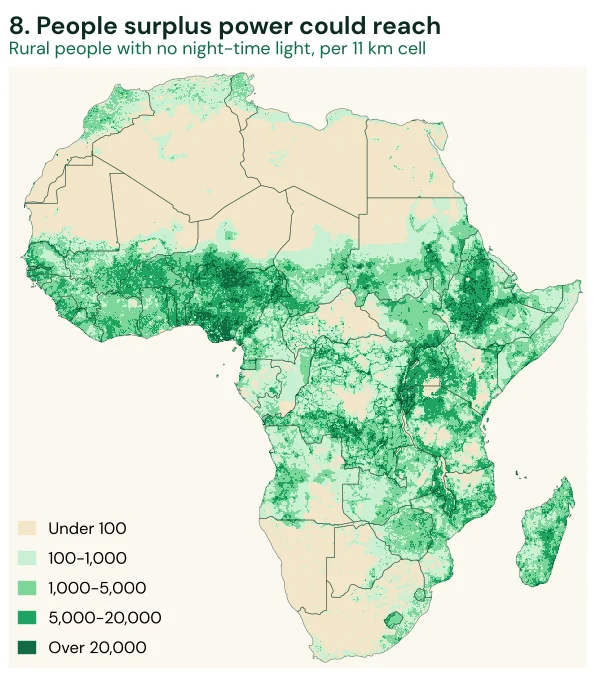
Not mapped: the rules, which are set out country by country below, and environmental constraints (protected areas, water use), because there is no open, reusable dataset for them across the continent. Sources for each map are listed under "How we did it".
The candidate regions side by side
The small hydro sites in each candidate region, with each factor shown separately. Shares and medians are over the sites in that region. Nothing here says a site is viable.
| Region | Small hydro sites (operating / future) | Rain in the driest 3 months (median) | Sites within 25 km of fiber | Sites under 21 °C (annual mean) | Distance to a 66 kV+ line (median) | Unlit rural people within 25 km (median) |
|---|---|---|---|---|---|---|
| Albertine Rift | 73 / 7 | 82 mm | 72% | 76% | 27 km | 387,000 |
| Kenyan highlands | 17 / 0 | 143 mm | 94% | 71% | 9 km | 124,000 |
| Ethiopia | 7 / 1 | 30 mm | 50% | 88% | 8 km | 299,000 |
| Madagascar | 13 / 0 | 42 mm | 85% | 85% | 32 km | 216,000 |
| Tanzania Southern Highlands | 7 / 0 | 7 mm | 57% | 71% | 15 km | 83,000 |
| Fouta Djallon (Guinea) | 5 / 0 | 6 mm | not in map* | 0% | 6 km | 134,000 |
| Lesotho | 3 / 0 | 33 mm | 0% | 100% | 27 km | 72,000 |
| Rest of Africa | 186 / 60 | 23 mm | 50% | 40% | 24 km | 82,000 |
* Guinea's national fiber backbone, opened in 2020, runs from Conakry through Mamou to Labé but is missing from the open fiber map we used. Northern Malawi and Cameroon's western highlands have one mapped small hydro site each, too few to describe. The Albertine Rift here is Rwanda, Burundi, Uganda west of 31.5° E and eastern DR Congo.
Planned small hydro the map does not show
National lists collected by UNIDO name more planned small hydro in East Africa than the open atlas we mapped. They have no coordinates, so they are counted here, not mapped. Some may have been built since 2022.
| Country | Future small hydro on our map | Projects in national lists (UNIDO 2022) |
|---|---|---|
| Burundi | 4 (52 MW) | 5 available for investment (29 MW) |
| Kenya | 0 | 5 under construction or planned (21 MW) |
| Madagascar | 0 | 3 under construction (2.7 MW) and 5 ready for tender (14 MW) |
| Malawi | 0 | 2 ongoing (9.5 MW) |
| Rwanda | 0 | 10 planned (52 MW) |
| Tanzania | 3 (80 MW) | 5 ongoing (4.4 MW); the regulator's register also lists provisional generation licenses for at least three hydro companies (2023-2025), without sizes |
| Uganda | 4 (61 MW) | 5 ongoing (47 MW); about 20 in various phases in 2020 |
Our map: African Hydropower Atlas v2.1, plants under 30 MW. National lists: UNIDO and ICSHP, World Small Hydropower Development Report 2022, Eastern Africa chapters (each country's own definition of small hydro, from 5 to 20 MW).
Reading the table
- Albertine Rift: the most small hydro, two rainy seasons that keep rivers running, fiber close by, cool air and the most people without power nearby. Weak points: a thin grid and insecurity in eastern DR Congo.
- Kenyan highlands: rain in the dry season, fiber and grid very close, cool. Fewer sites, and Kenya's grid is strong enough that a data center may simply buy grid power.
- Madagascar's highlands: cool and mostly near fiber, with a moderate dry season and few sites in the open data.
- Ethiopia and Tanzania's Southern Highlands: cool, but a long dry season. Ethiopia's own experience with miners is the warning.
- Fouta Djallon: rivers, but an almost rainless dry season and warmer air.
- Lesotho: very cool, few small sites, far from fiber in the open map; its data center plan rests on large hydro.
The Albertine Rift
Rwanda, Burundi, western Uganda and eastern DR Congo: dry-season rain, fiber and grid, temperature and the people surplus power could reach, with the small hydro sites on each map.
Data, security and crypto rules, country by country
Where the computing load handles personal data, data protection law decides where it may sit. Four of the countries below now require some data to stay in the country, and DR Congo and Tanzania need an approval for every transfer abroad, which can create local demand for an in-country site. Computing that holds no personal data, such as bitcoin mining or rendering, mostly falls outside these laws but not outside crypto and energy rules. About 44 African countries had a data protection law by early 2026, and 38 had a regulator at work (Digital Policy Alert, January 2026).
| Country | Data protection law | Must data stay in the country? | Sending data abroad | Crypto mining | Security and connectivity |
|---|---|---|---|---|---|
| Rwanda | Law 058/2021; regulator NCSA | Yes. Personal data must be stored in Rwanda unless the regulator's registration certificate allows storage abroad. | Regulator's authorization with safeguards, or consent or necessity; written contract | Prohibited unless approved by the Capital Market Authority (virtual asset law in force May 2026) | No shutdown recorded in 2025 |
| Ethiopia | Proclamation 1321/2024; regulator Ethiopian Communications Authority | Yes. Data collected in Ethiopia must be stored on a server or data center in Ethiopia; the regulator may list data that can only be processed there. | Adequacy decision, consent or necessity; sensitive data needs prior authorization | Licensed since 2022 as "data center and cloud services"; crypto payments prohibited; no new mining power contracts since 2025 | Shutdowns recorded in 2025 |
| DR Congo | Digital Code 2023 (ordonnance-loi 23/010); no data protection authority yet | In effect, for personal data. No personal data may go abroad without the data protection authority's approval (the telecom regulator acts until it exists), and the approval procedure is not yet set. | Prior approval (art. 187); an equivalent-protection test (art. 201); exceptions such as explicit consent (art. 202) | Not found | Goma cut off in 2025 during the conflict; broad state powers to suspend services |
| Kenya | Data Protection Act 2019; regulator ODPC | Partly. Data processed for strategic state interests, and critical information infrastructure, must be in Kenya; under the 2025 government cloud policy, top secret and restricted government data must be hosted in Kenya. | Safeguards, adequacy, necessity or consent; 2026 guidance treats cloud hosting abroad as a transfer | Virtual Asset Service Providers Act 2025; mining not addressed | Shutdown during the 2025 protests |
| Uganda | Data Protection and Privacy Act 2019; regulator PDPO | No general rule found | Country with equal protection, or consent | No crypto law; courts say crypto is not legal tender | Facebook blocked since 2021 |
| Tanzania | Personal Data Protection Act 2022; regulator PDPC | No general rule found | A permit for every transfer, even to adequate countries; national security is a ground for refusal | No crypto regime; 3% tax on digital asset transfers (2024) | Eight shutdowns in 2025, including a five-day election blackout |
| Burundi | Law 1/03 of 10 March 2026, its first, in force on signature; regulator: a data protection agency still to be set up | No rule in the law text | Only to countries on a government list of adequate protection, or with safeguards approved by the agency (arts. 15-16) | Not found | No shutdown recorded in 2025 |
| Malawi | Data Protection Act 2024; regulator MACRA (from January 2025) | No rule found | Recipient with adequate protection or approved safeguards | Unregulated; central bank cautions against crypto | No shutdown recorded in 2025 |
| Madagascar | Law 2014-038; regulator CMIL, being set up in 2026 | No rule found | Not found | Not found | No shutdown recorded in 2025 |
| Cameroon | Law 2024/017 (December 2024), compliance due June 2026; authority being set up | No rule found | Prior authorization may be needed | Not found | Shutdowns recorded in 2025 |
| Guinea | Law L/2016/037 on cybersecurity and personal data; 2025 decree on civil registry and ID data | No rule found | Not found | Not found | Shutdowns recorded in 2025 |
| Lesotho | Data Protection Act 2012; commission not yet appointed | No rule found | Not found | Not found | No shutdown recorded in 2025 |
| For reference: Nigeria | Data Protection Act 2023; regulator NDPC | Partly. Payment data generated in Nigeria must be stored there from January 2027 (central bank). | Adequacy or safeguards | Digital assets regulated as securities (2025) | Shutdowns recorded in 2025 |
| For reference: South Africa | POPIA 2013; regulator Information Regulator | No general rule found | Adequate protection, consent or contract | Crypto is a financial product (2022); licensed providers | No shutdown recorded in 2025 |
"Not found" means we found no public source, not that no rule exists. Laws change fast: check the current text before relying on any row. This is not legal advice. Sources: national laws as summarized by DLA Piper, PwC Rwanda, Covington, Afriwise, Clyde & Co, TechHive, CIPIT, LEX Africa, CIO Mag, OSIRIS and Paradigm Initiative; Digital Policy Alert (2026); Access Now, KeepItOn 2025 report (shutdowns); New Times and Ecofin (Rwanda 2026 law); Webber Wentzel / ALN and Chambers (crypto rules).
What it means for a hydro-powered site
- Local data, local servers. In Rwanda, Ethiopia and, for state and critical systems, Kenya, data that must stay at home needs an in-country site. That is demand a small, clean edge site could serve.
- Mining has its own rules. Rwanda now needs the market regulator's approval for any mining; Ethiopia licenses it but has stopped signing new power contracts for it.
- Shutdowns matter more than distance. In 2025, 30 internet shutdowns hit 15 African countries, mostly around protests and elections. A site serving users needs links that stay up; batch work that can wait copes better.
- Two sets of transfer rules. Hosting a neighbor's data means meeting the sending country's export rules and the host country's own law at once.
For four kinds of reader
Hydro developers
A computing load can buy power the town cannot use yet. Contract it as interruptible, with the community first in line, and plan for the dry season with a grid tie or solar and batteries.
Data center operators
Small hydro alone suits workloads that can pause. For anything uptime-rated, treat the plant as the cheap part of a mix that also has the grid, storage or a second source, and check fiber capacity, not just distance.
Funders
An anchor customer can make a small plant bankable. Ask for measured flow records, a dry-year plan and a written community share of power and revenue before counting the computing income.
Governments
Clear rules for self-supply, selling surplus to nearby homes and water use would let these deals happen in the open. Ethiopia shows why tariffs and curtailment terms should be set before, not after, a drought.
What a developer would need to check next
- Measured river flow at the site for at least ten years, not modeled monthly profiles.
- The firm power in the driest month of a dry year, and what covers the gap: grid import, solar and batteries, or pausing the load.
- A fiber route and a second path, with real capacity and price.
- The licensing route for generation, self-supply and selling surplus; data location rules; water rights.
- Protected areas, resettlement and other water users downstream.
- A contract that sets the community's share of power and revenue.
Method, sources and updates
How we did it
Small hydro. Plants under 30 MW from the African Hydropower Atlas v2.1 (IRENA and Sterl et al., CC BY 4.0), with its existing, committed, planned and candidate plants, plus operating plants in OpenStreetMap (ODbL) that are not within 3 km of an atlas plant. 37 OpenStreetMap plants have no size; we keep them because hydro plants without a size tag are mostly small. Future plants are undercounted in East Africa, and so are some operating ones: Rwanda's utility counts 37 grid-connected hydro plants and 11 off-grid micro plants, against 22 Rwandan sites on our map. The national lists in the UNIDO World Small Hydropower Development Report 2022 give names and sizes but no coordinates, so we show them as counts in the table below rather than on the map.
Dry seasons. Rain in the driest three months from CHELSA v1.2 climatologies (CC0), and the atlas's monthly capacity factors for a dry year where a plant has them. The atlas models flow for river basins of 3,500 km² and up, so a small plant's profile reflects the larger river it sits on.
Fiber, grid and cooling. AfTerFibre operational terrestrial routes (NSRC, CC BY 4.0), read in November 2026; coverage varies by country. Existing lines of 66 kV and above from the World Bank's 2017 Africa grid map (CC BY 4.0), so newer lines are missing. Mean annual temperature from CHELSA; hours of free cooling would need hourly data and are not shown.
Demand and drought. GeoNames cities over 100,000 people (CC BY 4.0), mine areas from Tang and Werner (2023, CC BY 4.0), rural people with no detectable night-time light in 2024 (Hengl rural population and VIIRS, CC BY 4.0), and the hydro share of capacity from our hydro and drought analysis (17 countries).
Each factor is computed on a 0.1° grid (about 11 km) and at each site. No composite scores and no rankings. Sites are not named; results are reported by region.
Sources
Sterl et al. (2021) and the African Hydropower Atlas v2.1 (IRENA, HydroShare); UNIDO and ICSHP, World Small Hydropower Development Report 2022; Rwanda Energy Group; OpenStreetMap contributors; NSRC AfTerFibre; World Bank Africa electricity grid (2017); Karger et al. (2017) CHELSA; GeoNames; Tang and Werner (2023); Hengl (OpenGeoHub) and the Earth Observation Group VIIRS night lights; Aloe Energy hydro exposure (2026). Cases: MIT Technology Review (January 2023); The Continent and Follow the Money (October 2025); CNBC (April 2024); The Reporter Ethiopia (August 2025); Capital Ethiopia (October 2025 and September 2026); Ethiopian Business Review (August 2026); African Business (December 2025); africa.com (July 2026); OSIRIS (2017) and Huawei (2022) on Guinea's backbone.
Not used because their terms do not allow reuse: GRDC river discharge, PeeringDB exchange points, the TeleGeography cable map and the World Database on Protected Areas.
Public data only. A screen, not a site study, and not investment advice. Nothing here says a site is viable.
What changed 5 updates
We review this once a year: new small hydro plants, new fiber routes, new cases of hydro-powered computing and any change in the rules.
- 13 November 2026 - Burundi row checked against the law text (no storage rule; transfers to listed countries or with approved safeguards). Tanzania: the regulator's license register adds at least three hydro developers.
- 13 November 2026 - Rules table updated: Burundi's new law (1/03 of March 2026), DR Congo's approval rule for sending personal data abroad, and Kenya's 2025 cloud policy, which keeps top secret and restricted government data in Kenya.
- 13 November 2026 - New section on the rules: data protection and data localization laws, crypto mining rules and 2025 internet shutdowns for the candidate countries, with Nigeria and South Africa for reference.
- 12 November 2026 - Source check: added a table of planned small hydro from national lists (UNIDO 2022) that the map does not show, and a note that Rwanda's operating plants are undercounted. The maps and findings are unchanged.
- 12 November 2026 - First edition: 381 small hydro sites, eight factors across Africa, nine candidate regions and a closer look at the Albertine Rift.
Quote or embed it
Free to quote and embed with credit (see our data and terms). To embed the page:
Cite it
APA, with the date you viewed it:
BibTeX:
Common questions
Can hydropower run a data center in Africa?
Large hydro already powers national grids that data centers use, in Ethiopia, DR Congo, Uganda and elsewhere. Small run-of-river hydro on its own can run computing that can pause in the dry season. A data center that must run all year needs a grid connection, storage or a second source as well, because most small plants produce very little in the driest month of a dry year.
Where in Africa could small hydro power computing?
On the factors we could map, the Albertine Rift (Rwanda, Burundi, western Uganda and eastern DR Congo) lines up on the most at once: many small hydro plants, rain in the dry season, fiber nearby and a cool climate. The Kenyan and Malagasy highlands follow on several factors. This is a screen, not a site study.
Is bitcoin mining on small hydro happening in Africa?
Yes. Since 2020 a mine has used power from a run-of-river plant in Virunga National Park, DR Congo, and Gridless runs small mines at renewable mini-grids, including a hydro pilot in Kenya. Ethiopia's much larger mining industry runs on its national, mostly hydro grid and was cut to about 23% of its contracted power in the 2026 drought.
Why not use small hydro for a large data center?
Small hydro plants are a few megawatts; the median on our map is about 6 MW. Large commercial data centers need tens to hundreds of megawatts, two power feeds and two fiber routes, and sit near the big cities and submarine cable landings.
Does a computing customer help the community?
It can, by paying for power the community cannot use yet and lowering the tariff for everyone else, as in the Kenyan hydro pilot reported by CNBC. It does not have to: at Virunga, reporters found that most mining income goes to the private operator. The contract decides.
Do data protection laws matter for a data center in Africa?
Yes, if it holds personal data. About 44 African countries have a data protection law, and several now require some data to stay in the country: Rwanda for personal data unless the regulator allows otherwise, Ethiopia since 2024, Kenya for state and critical systems, and Nigeria for payment data from 2027. DR Congo and Tanzania require an approval before personal data leaves the country. Those rules can favor an in-country site. Bitcoin mining and other computing without personal data mostly fall outside them, but under crypto and energy rules instead.
Can I get the data?
The maps are free to view and quote with credit. The data behind them is available on request by email, like all our research data.