
Indian Ocean island state
Seychelles electricity grid and access
This page brings together what our open atlases show for Seychelles: about 4 km of high-voltage lines, 99 MW of power plants and the projects still to come.
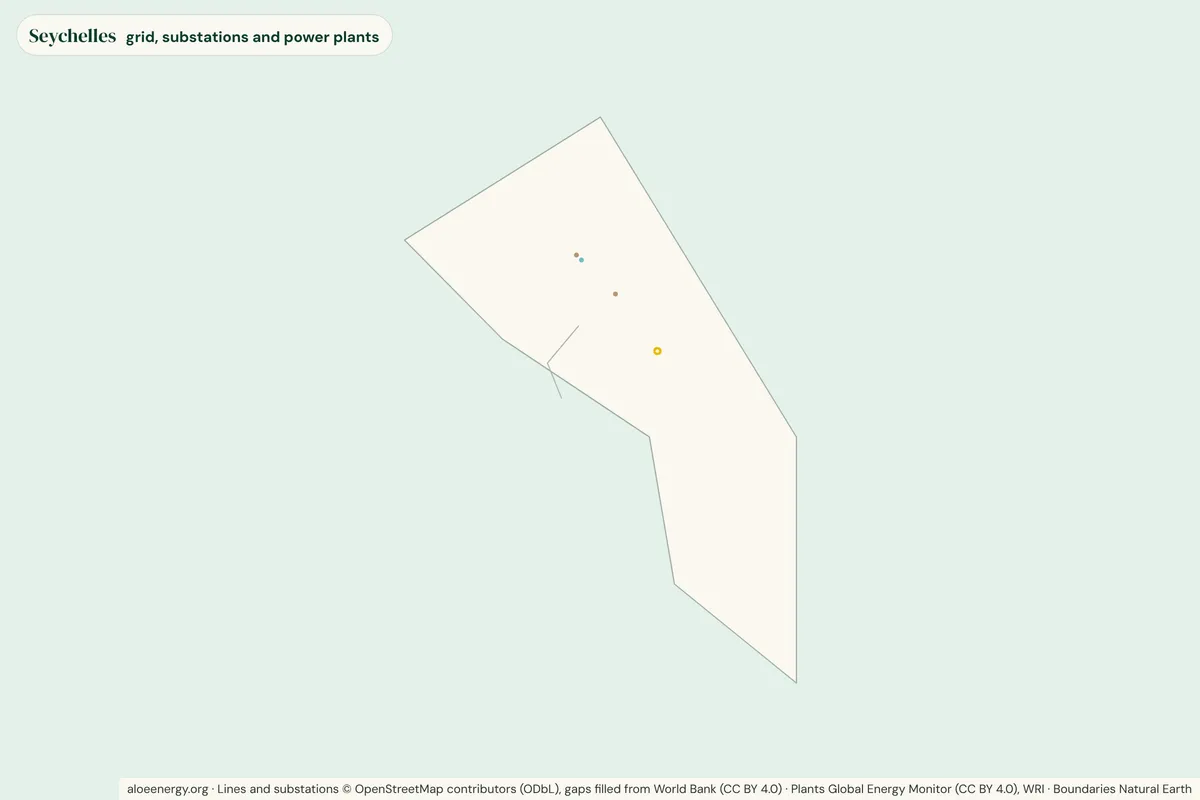
Lines, substations and demand
Seychelles' mapped high-voltage network runs to about 4 km of lines at 66 kV and above. Installed capacity was about 140 MW (2024). The latest international tracking report puts access to electricity at 100% of people.
| Voltage | km |
|---|---|
| Voltage not recorded | 4 |
| Total | 4 |
Power plants and projects
Four operating power plants of 10 MW and above add up to about 99 MW, 94% of it oil. The largest is Victoria C (Roche Caiman) power station (58 MW, oil). Another 2 plants totaling about 22 MW are under construction or planned, 6 MW of them under construction. Most of the pipeline is oil. One early-stage project, Victoria C (Roche Caiman) power station, accounts for 73% of that, so the total says more about ambition than about what will be built soon.
| Type | Operating MW | Pipeline MW |
|---|---|---|
| Oil | 93 | 16 |
| Solar | 6 | |
| Wind | 6 | |
| Total | 99 | 22 |
More about Seychelles
Open any topic for the full text and tables.
Waste to WealthSecond life for solar and batteries
Between 2026 and 2040, about 70 tonnes of solar equipment and stationary batteries are expected to retire in Seychelles, most of it solar panels. That is 0.0% of the total for the 49 countries in our second-life atlas. Up to 2 MWh of retired batteries could be tested and reused as storage, for example in solar home systems, shops and mini-grids (0.0% of the atlas total). Eastern Africa has e-waste collection and dismantling, in Kenya and Rwanda, but no recycler for panels or lithium batteries yet, so this waste would have to travel to South Africa, mostly by sea to Durban.
| Stream | Tonnes | Share of country |
|---|---|---|
| Solar panels | 44 | 63% |
| Batteries | 26 | 37% |
| Total | 70 | 100% |
| Seychelles | Atlas total | Share | |
|---|---|---|---|
| Retiring solar and batteries (tonnes) | 70 | 507,091 | 0.0% |
| Reusable battery storage (MWh) | 2 | 4,664 | 0.0% |
| Retiring in 2030 (tonnes) | 3 | ||
| Retiring in 2035 (tonnes) | 5 | ||
| Retiring in 2040 (tonnes) | 7 |
From our second-life atlas, central case, by country. Electric vehicle batteries are modeled for the region as a whole, so they are not in these country figures.
EmissionsGrid emission factor
Each megawatt-hour generated in Seychelles in 2024 came with about 0.64 tonnes of CO2. For carbon projects such as solar mini-grids, the combined margin (the usual basis for crediting) is about 0.67 tCO2/MWh. Looking ahead, our scenarios from the plants in the pipeline put the average at 0.64 tCO2/MWh in 2030 and 0.64 in 2035, depending on how many plants arrive on time (see the scenarios). We have not yet rated the quality of its data. See our grid emission factors for the method and all 49 countries.
Grid mix, 2024.
Oil and diesel 84% Solar 14% Wind 2%
| Measure | tCO2/MWh |
|---|---|
| Generated in country | 0.641 |
| Electricity used, with imports | 0.641 |
| Combined margin (for carbon projects) | 0.673 |
Tariffs and load sheddingWhat power costs here
Public Utilities Corporation (PUC)'s Domestic sector, first block tariff, in force from 15 January 2025. Our utilities, tariffs and load shedding page compares 49 African countries by customer class, with what each tariff includes and load shedding since 2015.
| Measure | Value |
|---|---|
| Household (0-200 kWh/month) | 1.97 SCR/kWh, about US$0.142 |
| Load shedding now | No load shedding reports found (searched 19 Nov 2026) |
Energy charge only, at the central bank rate on 30 October 2026. Check what is included (VAT, levies, fixed charges) on the research page.
Grid consumptionWho uses the power on the grid
Households used about 43% of the country's electricity in 2023, by UN estimates. We have not found an official split by customer class yet. Our grid consumption page compares sales by customer class, power use per customer and peak demand across 49 African countries.
| Measure | Value |
|---|---|
| Households (UN) | 43% |
| Commercial and public (UN) | 29% |
| Industry (UN) | 28% |
| National use, UN 2023 | 512 GWh * |
UN: UN Energy Statistics Database (UNdata). * UN estimate or a single figure from a news report.
Certificates and carbon creditsRenewable energy certificates
Seychelles cannot issue I-RECs, the international renewable energy certificate, yet. No carbon credit projects are listed for it on the voluntary registries. See our certificates page to compare certificates with carbon credits across the region.
| Measure | Value |
|---|---|
| I-REC status | Not approved |
| Registered plants | - |
| I-RECs issued, all years | - |
| Carbon credit projects | 0 |
| Carbon credits issued | - |
I-RECs: Xpansiv I-REC Registry statistics, October 2026. Carbon projects: CarbonPlan OffsetsDB (Verra, Gold Standard and other voluntary registries), data to June 2026. Article 6: UNEP Copenhagen Climate Centre Article 6 Pipeline, November 2026.
From power plant to battery siteWhen the thermal plants close
Seychelles has 1 coal, gas or oil plant site of 50 MW or more, with 58 MW of grid connection. None of it frees up before 2030 in our central case.
| Plant | Fuel | Connection (MW) | Frees up |
|---|---|---|---|
| Victoria C (Roche Caiman) power station | Oil | 58 | 2050 |
Timings, cases and every site: power plant to battery site.
Second lifeWho could use a second-life panel
Places in Seychelles that could use a second-life solar panel add up to about 15 MWp (range 7 to 35): 15 MWp to cut generator use in towns, 0 MWp for mini-grids, 0 MWp for household systems and 0.0 MWp for 0 health facilities and 0 schools with no light at night.
Mapped by half-degree cell, with years to 2040: where the panels are needed.
E-mobilityElectric transport, per km
On Seychelles' grid, an electric motorbike emits about 44 g of CO2 per km from the power it charges with, against 48 g for a petrol one (7% less).
| Vehicle | Electric | Petrol or diesel | Difference |
|---|---|---|---|
| Motorbike | 44 | 48 | -7% |
| Bus | 830 | 1,673 | -50% |
| Small car (newer petrol car) | 133 | 125 | +6% |
Life-cycle figures, a cost calculator and city air: e-mobility.
Neighbors, sources and updates
Sources 8 sources
- Grid lines: OpenStreetMap contributors (ODbL), with gap-fill from the World Bank Africa electricity grid (2017).
- Power plants: Global Energy Monitor, Global Integrated Power Tracker (September 2026), with WRI and curated public project sources.
- Capacity and access: national regulators and utilities, and the Tracking SDG7 Energy Progress Report 2026.
- Retiring solar and batteries: our second-life atlas model (central case, regular losses), from public project registers and IRENA lifetimes.
- Emission factors: our grid emission factors (Ember, 2024).
- Thermal plant sites: Global Energy Monitor, Global Integrated Power Tracker (September 2026), and our thermal-to-storage model.
- Second-life demand: grid-edge screening, compact targets, World Bank Enterprise Surveys and health and school facility lists, in our second-life atlas.
- Transport per km: our grid emission factors and vehicle energy use; running costs from national pump prices and tariffs.
The maps are free to view. The data behind this page is available on request: email [email protected]. Lines are indicative, not for engineering or investment decisions.
More data
More in the Madagascar and Indian Ocean grid atlas, grid-edge atlas, second-life atlas and grid emission factors, or see all countries.
What changed 3 updates
Our data is checked every month, and this page is rebuilt after each check.
- 19 November 2026 - Latest update to the Madagascar grid atlas, which this page is generated from.
- 19 November 2026 - Mauritius and Seychelles added: their lines and substations from OpenStreetMap, power plants from Global Energy Monitor and WRI, towns, and installed capacity and peak demand on the Region tab.
- 19 November 2026 - Latest update to the grid-edge atlas, which this page is generated from.
Common questions about Seychelles
Where can I find a map of Seychelles's electricity grid?
The free Madagascar and Indian Ocean grid atlas maps Seychelles' high-voltage lines, substations, power plants of 10 MW and above and planned projects. Open it zoomed to Seychelles.
How long is Seychelles's transmission network?
About 4 km of mapped lines at 66 kV and above, mostly from OpenStreetMap.
How much power generation does Seychelles have?
Operating plants of 10 MW and above add up to about 99 MW in our atlas, with about 22 MW more under construction or planned.
What is the grid emission factor for Seychelles?
About 0.64 tCO2/MWh for electricity used in 2024, and 0.67 tCO2/MWh as a combined margin for carbon projects. See our grid emission factors for the method.
Can I get the data for Seychelles?
Yes, on request. The maps are free to view; email [email protected] and tell us what you need it for.
 Spotted an error, or something missing on this page? Report an issue or send feedback