
Grows where the grid hasn’t.
The Maghreb (COMELEC) grid atlas
One map of North Africa's western power system: Morocco, Algeria, Tunisia and Libya, with Western Sahara shown as a disputed territory. The grid today, every power plant of 1 MW and above, the links to Europe and the cross-border projects still to come.
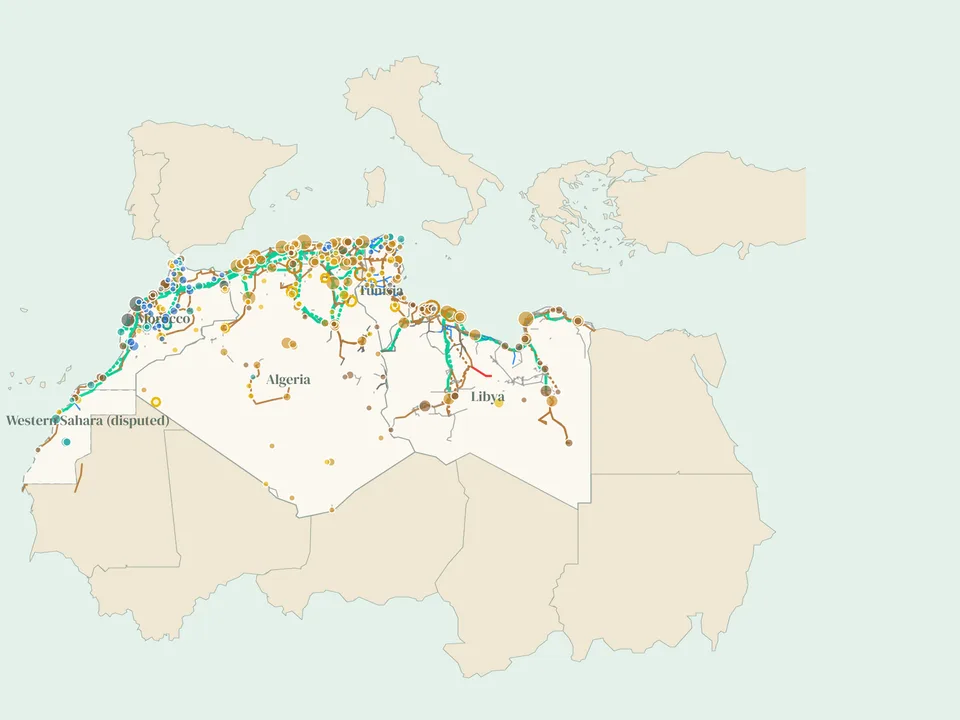
A grid built for gas, opening to Europe
Everyone in Morocco, Algeria and Tunisia has a connection; in Libya about 77% did in 2024. The question here is not access but supply, trade and the shift away from gas and coal.
- Two 400 kV cables join Morocco and Spain (1,400 MW). Spain sent Morocco a net 3,743 GWh in 2025, and in April 2025 power from Morocco helped restart southern Spain after the Iberian blackout.
- ELMED, a 600 MW HVDC cable from Tunisia's Cap Bon to Sicily, started construction in June 2026; completion could slip from 2028 to 2031.
- Algeria exported about 3.1 TWh to Tunisia in 2025, 14% of Tunisia's supply. A Morocco - Mauritania 400 kV line would join the Maghreb to the West African Power Pool.
Politics and peaks
The Morocco - Algeria lines have carried nothing since Algeria closed the Maghreb-Europe gas pipeline in 2021. Libya's demand peaks near 8,000 to 9,000 MW against about 6,500 MW of working capacity, and Tunisia leans on Algerian imports at its summer peak. Egypt, linked to Libya, is in our EAPP atlas.
Solar and storage close to demand can cut both the fuel bill and the summer peak.
Print the map
Two A0 posters of the Maghreb grid, free to download: the grid and power plants today, and everything planned to 2035 and beyond. There is also an A2 pair for each country.
Free to print and share for non-commercial use with credit to Aloe Energy, unchanged (CC BY-NC-ND 4.0). A0 (841 x 1189 mm); prints well at A1 too.
Sources and updates
Sources
Grid lines, substations and some plants from OpenStreetMap (extracted 22 November 2026; openstreetmap.fr extracts for Morocco, Western Sahara, Algeria and Tunisia, the Overpass API for Libya), with gaps filled from the World Bank (2017) map. Plants from Global Energy Monitor's Global Integrated Power Tracker (September 2026, CC BY 4.0), then the WRI database, OpenStreetMap and the World Bank AICD list where GEM has nothing. Peak demand from ONEE, Sonelgaz, STEG and GECOL; interconnectors from Red Electrica, the Moroccan energy ministry, Sonelgaz and press; projects from the EU T-MED initiative, AU PIDA, the World Bank, the EBRD and utilities. COMELEC has no published master plan with dates. Access from the World Bank (2024).
All four countries have their main 220-400 kV networks in OpenStreetMap. Libya's lines come in many short sections, so line counts run high while lengths are right. We publish what the open data shows and add to it every month.
The data
The map is free to view. For the underlying data, email [email protected].
Western Sahara is drawn with a dashed border, as the United Nations and most open map data show it. Routes for projects are indicative, and the map is not for engineering or investment decisions. Email [email protected] to send a correction.
Sources behind each feature
Every line, substation, plant and project on the map lists the public sources that show it. Click a feature to see them, or set "Color lines by" to "Number of sources". Of 81,576 km of line in the COMELEC grid atlas, 8% is confirmed by two or more sources and 92% rests on one. Of 266 operating power plants, 102 appear in two or more sources. Counts as of 22 November 2026.
OpenStreetMap lines also shown in:
- World Bank Africa grid map (2017): 6,386 km
The rules are the same for all our grid atlases: what counts as a source.
What changed 2 updates
Every month we check COMELEC members' utilities, funders and project news for new lines, plants and dates, and update the map. Each change keeps its source.
- 25 November 2026 - Free posters: two A0 sheets of the Maghreb grid, today and to 2035 and beyond, and an A2 pair for each country, in English, French and Portuguese. Download them from this page or from Posters.
- 22 November 2026 - First edition published: Morocco, Algeria, Tunisia and Libya (Libya is also in the EAPP atlas), with Western Sahara drawn as a disputed territory. The grid from OpenStreetMap (66 kV and above, plus lines with no voltage tag) with gaps filled from the World Bank 2017 map, 405 power plants of 10 MW and above and 38 more from 1 MW, 12 cross-border lines and projects, 5 interconnectors and five constraints. Same tools as our other grid atlases.
Get these changes by email
Once a month we send one short email with what changed across all our atlases and pages, each change with its source, plus new research and open data.
Common questions
Where can I find a map of the North African power grid?
Right here. The COMELEC grid atlas is a free interactive map of the grid in Morocco, Algeria, Tunisia and Libya: transmission lines, substations, power plants of 1 MW and above, interconnectors and the cross-border project pipeline. Egypt is in our EAPP grid atlas, and all of Africa is on one map in the Africa grid atlas. Open it full screen.
What is COMELEC?
The Comite Maghrebin de l'Electricite, the Maghreb electricity committee of Morocco, Algeria, Tunisia, Libya and Mauritania. Mauritania is mapped in our WAPP atlas, and Libya, a member of both COMELEC and the Eastern Africa Power Pool, is in both atlases.
How is Western Sahara shown?
With a dashed border and the label "disputed", as the United Nations and most open map data show it. The lines and plants there are on the map; no country figures are given for the territory.
Which links to Europe are on the map?
The two Morocco - Spain cables in service, the planned third cable, a Morocco - Portugal link in studies and ELMED, the Tunisia - Italy cable under construction. The UK government declined to support the Xlinks Morocco - UK project in June 2025, so it is noted but not drawn as a live plan.
Can I download the data?
The map is free to view. The underlying data is available on request: email [email protected].
How often is it updated?
Every month, with each change and its source listed in the changelog on this page.
 Spotted an error, or something missing on this page? Report an issue or send feedback